
frequently asked questions
Questions we would like to answer:
Natural Stone is one of the oldest and most elementary building materials – and a main habitat for lichen. With new techniques it is possible to form stones faster and in more diverse shapes. Hence it is still pioneering work to design these techniques.
Stone also has antibacterial behavior, is easy to clean and will last very long. The multi-sensorial experience with stone is also pretty unique.
Yes, it is proof and we didn’t have any issues.
However, if possible please wash it by hand.
Even if it is stone, please be careful with the cups. Despite the materials, the cups can be fragile.
If the objects have a crack, please reach out at contact@simiaen.com
Simiaen – Natural stone cups and tableware are manufactured in southern Burgenland (Austria) by Stein Schwarz.
Simiaen emerged from the docu-fictional project Unseen Edible, in which Julia Schwarz imagines a world where lichen are prevalent and commonly consumed. Lichen are a composite organism of algae and fungi and they offer a great deal of nutritional value. They are rich in Vitamin D, B12, Mg, Fe & Iod.
Lichen are categorized novel food and not yet approved for the conventional food market. However, in the pharmaceutical industry they are registered and commonly used. You may also know Icelandic Moss from your lozenges for a sore throught
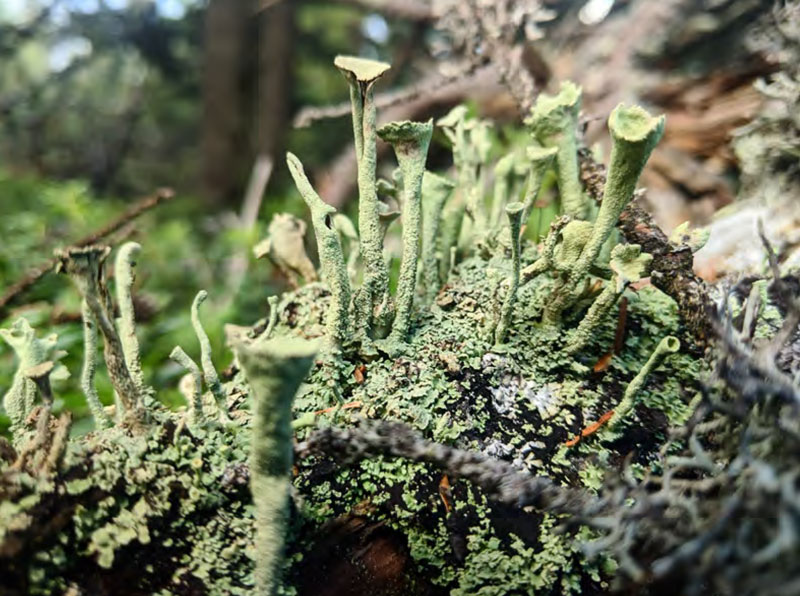
Although lichens and mosses are often confused because they grow in similar places and are both usually small and greenish or grayish (sometimes lichens even have misleading names such as “Iceland moss”), they are fundamentally different biologically: Lichens are not plants, but rather a fascinating symbiotic relationship between a fungus and an alga (or cyanobacterium), in which the fungus provides protection and the alga produces food through photosynthesis. Mosses, on the other hand, are independent plants (more specifically, bryophytes) that perform photosynthesis themselves and have simple stems, leaves, and adhesive roots. The main difference is therefore that mosses are plants, while lichens represent a unique cooperation between fungi and algae.
Iceland moss (scientific name Cetraria islandica) is a lichen that has been used traditionally and scientifically primarily to relieve respiratory complaints. It is particularly well known for its ability to soothe dry coughs, sore throats, and hoarseness. This is due to the mucilage it contains, which forms a protective film over the irritated mucous membranes in the mouth and throat when it comes into contact with moisture. This alleviates the urge to cough and promotes the regeneration of the mucous membranes. In addition, Iceland moss can also stimulate the appetite and help with mild digestive problems thanks to the bitter substances it contains. It is available in the form of lozenges, cough syrups, or teas. We have tea blends containing Iceland moss in our range, in cooperation with Kottas. We produce Iceland moss flavor extract for beverages.
A lichen is a fascinating symbiotic community consisting of two different partners: a fungus and an alga (or cyanobacterium). These two live together in a kind of “shared living arrangement”: the fungus provides protection and support, while the alga produces food for both partners through photosynthesis. Thanks to this cooperation, lichens can thrive in places that would be inhospitable for either partner alone, such as on bare rocks, tree bark, or in extreme climates. Lichens are also important bioindicators of air quality.
Definitely yes! Lichens are much more than just growths on trees and rocks. They play a crucial role in the health of our environment and offer a wealth of potential and real benefits for humans. Modern research is intensively investigating lichens for potential antibiotic, antiviral, anti-inflammatory, or even anti-cancer agents, as they produce a variety of unique lichen substances. They are pioneer plants and important for soil formation: lichens are often the first organisms to colonize bare rocks and soils (pioneer vegetation). Certain types of lichen have been used as a food source in times of need or in specific cultures. However, they require extensive preparation to remove bitter substances and toxins. We use the lichen Iceland moss.
Lichens are an indicator of a healthy environment, which means they are indirectly healthy for us! The presence and diversity of lichen species in an area are therefore an excellent indicator of air quality. Lichens are largely unsuitable and potentially dangerous for direct human consumption, unless you have in-depth botanical knowledge and know how to prepare safe species. Thanks to the work of Julia Schwarz, we have succeeded in doing just that. This was one of the main reasons for founding Simiæn!
Natural stone is fundamentally a very sustainable building material due to its durability, recyclability, and naturalness. However, to maximize its sustainability, it is important to pay attention to regional origin, environmentally friendly extraction and processing, and a long service life. And that is exactly what we do: we use natural stone from southern Burgenland. This natural stone is even denser than granite. In addition, we only use the sections of black stone, thus ensuring circular economy production.
These materials differ fundamentally in terms of their origin and manufacture: Natural stone: This is a natural rock that is extracted directly from quarries and processed (e.g. granite, marble, slate). It is unique and is not fired. Ceramics: This is a generic term for products that are formed by humans from mineral raw materials (usually clay) and fired at high temperatures. Earthenware: This is a specific type of ceramic that is fired at relatively low temperatures. Its unglazed body is very porous and not frost-resistant. In summary: Natural stone is a pure natural product, while ceramics (and therefore also stoneware) are products made by humans from natural raw materials and fired, with stoneware being the most porous and lowest-fired type of ceramic.
Simiaen lichen tea is being produced in Vienna, Austria – in beautiful collaboration with Kottas pharmaceutics.
Simiæn Sprizz Non Alcoholic is bottled in Lower Austria
Simiæn Sprizz is bottled in Southern Burgenland, Austria